

OC Clinical Research · Current study
Clayton A. Chan, D.D.S., Principal Investigator
A multi-clinician retrospective case series examining whether physiologic convergence — across mandibular trajectory, muscle activity, and joint sound — predicts symptom resolution in TMD patients treated to a GNM orthotic position.
Initial findings from the first 14 cases are published here: The GNM Convergence Pilot Study: Initial Findings.
To determine whether the convergence of three independently measured physiologic domains — mandibular trajectory (CMS) Scans 2 and 7, muscle activity (sEMG) Scans 9 and 11, and joint sound (ESG) Scan 15 — corresponds with the resolution of paradigm-independent Patient Subjective Summary complaints (headache, joint noise, facial pain, functional limitation) before and after GNM orthotic therapy.
In simpler terms: when the K7 numbers move together in the directions GNM teaches they should, do the patients actually get better, and at what rate?
Most of the peer-reviewed literature critical of the K7 examines its measurement parameters one at a time — resting EMG by itself, kinesiographic recordings by themselves — and reports false-positive rates that, taken alone, raise questions about diagnostic accuracy. But GNM has never claimed that any single parameter, in isolation, diagnoses TMD or guides treatment. The clinical model has always rested on the convergence of trajectory, muscle, and joint measurements, correlated with imaging-grade findings and the patient’s signs and symptoms.
That convergent model has been taught and practiced for decades, and we have all seen it work in our offices. But it has not been documented in compiled form. Each of us holds the evidence in our own patient records and in our clinical experience. This pilot is the first step toward putting that evidence on paper — not as conviction, but as countable data.
The goal of this pilot is modest and specific:
If the pilot succeeds, the next phase will be a larger case series across a wider group of OC clinicians, with the goal of a formal writeup suitable for presentation or publication.
Publication goal: the compiled case series is aimed at peer-reviewed publication in CRANIO: The Journal of Craniomandibular & Sleep Practice or The Journal of Prosthetic Dentistry.
Submit data on one or more TMD patients from your practice who meet the inclusion criteria below. Even a single case is valuable; more than one is better.
Cases must be consecutive: a single case is your most recent patient who meets the criteria, and more than one means the most recent patients meeting the criteria, in chronological order — not the best outcomes, not your favorite cases. This is the single most important methodological rule and the one that protects the study from the standard skeptical criticisms.
A patient qualifies for inclusion if they meet all of the following:
All data points are already in the patient’s K7 record and chart. Nothing new needs to be measured on existing patients. For new cases going forward, make sure the Patient Subjective Summary is completed at intake and at follow-up.
For retrospective cases where the scores were not formally taken, estimate from chart notes and mark the estimate as such.
All of the above is captured in a single row of the shared spreadsheet template. One row per patient. Each doctor records raw values only — the analysis is centralized.
We provide a ready-made Excel spreadsheet template that makes the data gathering easy. To receive it, contact Dr. Clayton Chan at: clayton@drclaytonchan.com.
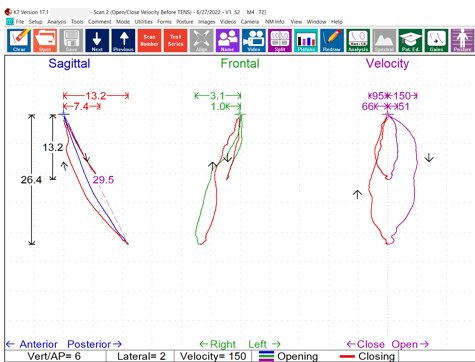
Here is one patient’s K7 scans before and after GNM orthotic treatment — exactly what each participating doctor collects for a case. Before = habitual bite; after = with the GNM orthotic in. Each screen shows the scan, trial, date and K7 version in its title bar. Click any image to enlarge it.
Record: the AV ratio from the sagittal trace, and terminal closing velocity (normal and wide-and-fast). After treatment, record Scan 2 or Scan 7 with the GNM orthotic in.

Record: the eight resting values in µV (LTA, RTA, LMM, RMM, LCG, RCG, LDA, RDA), read against the OC norms (TA 2.3, MM 1.3, CG 2.2, DA 1.7 µV).


Record: natural clench and cotton-roll clench in µV for LTA, RTA, LMM and RMM.


Record: the joint-sound signature — quiet, clicks, soft-tissue sounds below 300 Hz, or high-frequency sounds above 300 Hz.


Record: each symptom self-scored 0–5 (5 = severe), before and after. In this case the total went 56 → 26 → 24 → 9 → 0, from 6-28-22 to 5-17-26.

Shown with the patient’s identifying information removed.
This is specified before data collection, not derived from the data afterward. This protects the study from the standard criticism that GNM defines success retrospectively.
Each channel is read against the OC normative values:
A patient is classified by how many of the four scored channels (resting EMG, natural clench, recruitment gap, joint sounds) moved toward, or were at, the norm:
Do convergent responders show greater symptom resolution than partial or non-responders?
If yes, the convergence model is empirically supported and we have a real basis for a larger study and an eventual paper.
If no, or if the pattern is mixed, we have learned something important about which of our measurements actually predict outcome — which is also a valuable and publishable finding.
Either result is honest and worth having. The pilot is not designed to prove GNM right. It is designed to find out what the data shows.
Every doctor who submits a completed case will:
The 2009–2013 NM Research Group projects designed sound protocols and collected real data — Project 1 (30 clinicians, 41 asymptomatic patients) and Project 2 (21 clinicians, 55 symptomatic patients) were compiled and produced a published comparison in 2010. The pattern that limited their reach was that the studies depended on multi-clinician data submission to a central collector for raw K7 files, and the writeup step was variable.
This pilot is structured to remove those friction points:
If this pilot finishes, it is the first piece of compiled, multi-clinician, protocol-driven convergence data in the GNM literature.
We have practiced GNM for decades because we have seen what objective measurement reveals about our patients, and we have seen the results of treating to that optimized physiologic measured position. The criticism leveled at our instruments in the peer-reviewed literature has rarely engaged with how we actually use them — as a convergent set of physiologic signals, not as standalone diagnostics. This pilot is our first formal step toward putting on paper what we have seen in our offices.
We are not doing this to win an argument with academics who have no interest in measuring. We are doing it for ourselves — to confirm in compiled form what we have observed in individual patients all around the world, to strengthen the teaching for the next generation of GNM clinicians, and to leave a more complete record of our work than currently exists.
One case from you is enough and will make a huge difference. A real artifact at the end.
We encourage and welcome every OC dentist who records K7 scans in the office before and after GNM orthotic treatment to participate and contribute your case(s) to the current GNM Convergence Pilot Study. We need a bigger pool of data from all OC doctors. Even one case from you would be highly valued in this study. If interested, please contact Dr. Clayton Chan at: clayton@drclaytonchan.com.
We provide a ready-made Excel spreadsheet template that makes the data gathering easy. To receive it, contact Dr. Clayton Chan at: clayton@drclaytonchan.com.
