
GNEUROMUSCULAR ORTHODONTICS
Orthodontics and Orthopedics Built on a Measured Occlusion
Over the past 42 years, gneuromuscular dentistry has been steadily building its aesthetic orthodontic-orthopedic foundations on sound bio-physiologic principles. Three cornerstones support that foundation — the disciplines of occlusion, TMD, and orthodontic/orthopedics (growing and developing bone) — all grounded in bio-medical science and neuromuscular principles.
Correcting, balancing, and aligning the mal-aligned dental occlusal plane to a proper physiologic vertical dimension along an isotonic path of mandibular closure has been a hallmark of GNM orthopedic principles for long-term stability and success. Closing up a bite (VDO), or creating tooth contact to an unknown jaw position that has not been quantitatively tested against an involuntary isotonic closure path, will lead to orthodontic relapse and treatment mishaps. Diagnosis is key.

The lower removable orthotic is used as an “Orthopedic Matrix” to transition the bite.

Verticalization of the teeth, ligaments, and underlying bone occurs with slow, gentle forces.
Key One — A Strong Occlusal Philosophy
A strong G+NM occlusal philosophy based on bio-physiologic principles is the first key on which these teachings are built. Gnathic occlusal mechanics combined with neuromuscular occlusion brings the clinician and team a whole new paradigm for understanding what occlusion really is through objective measurements in determining the physiologic 6-dimensional bite position. Traditional concepts are enhanced to recognize that the teeth and supporting bone are not stand-alone components — the joints and muscles are an integral aspect of diagnosing cranio-mandibular orthopedic problems that relate to the complete masticatory postural system. Jaw tracking (Scan 4/5) combined with dental TENS aids the clinician to identify the unstrained (scan 9/10) physiologic antero-posterior, frontal/lateral, vertical, pitch, yaw and roll position of the mandible to begin not just diagnosis but effective ortho/orthopedic treatment.
Key Two — Recognizing the Musculoskeletally Compromised Patient
The second cornerstone is the understanding of musculoskeletal occlusal signs and symptoms on which the Advanced Orthopedic Dentist is founded. These fundamentals give clinicians an in-depth look at effective diagnosis and the clinical skills to identify the musculoskeletally compromised patient — and to treat these more challenging cases orthopedically in their own practices. Identifying abnormal tongue habits with instrumentation (Scan 6) to validate and confirm these underlying dysfunctions that restricted vertical and expansion growth patterns is key to normalizing facial form upper airway nose breathing development and the oral pharngeal jaw space.
Key Three — A Neuromuscular Orthodontic/Orthopedic Curriculum
The third cornerstone is a strong orthodontic/orthopedic curriculum espousing gneuromuscular (GNM) occlusion principles and advanced instrumentation to measure and record the bio-physiologic responses of muscle activity and cranio-mandibular relationships at the start of treatment, during and after treatment. Knowing the proper techniques, methods and protocols to orthopedically grow and developing bone, supporting tissues and jaw posture along the isotonic myo-trajectory results in achieving treatment success. These disciplines are core to the clinical experience of the high-end general dentist and orthodontic specialist searching for clinical answers.
Without good gnathic mechanics of anterior disclusion, true posterior vertical growth of the posterior teeth cannot be effectively achieved. Understanding intra-oral cavity development, aberrant tongue containment, airway breathing, and jaw positioning, along with sound cranio-mandibular orthopedic verticalization techniques, allows clinicians to excel in facial development and optimal occlusal stability of the stomatognathic neuromuscular system non-surgically. Following natures organic design is Biotensigrity.
A Need for Gneuromuscular Orthopedic Treatment
Based on the prevalence of malocclusion in the general population, there is a large unmet need for orthodontic treatment. The prevalence of mal-occlusions — and the need for care — has not really changed over time, but the demand for care has increased significantly. Narrow arches, airway breathing problems, compromised vertical dimensions of occlusion, and underdeveloped smile profiles are just some of the problems that must be addressed. The overall gneuromuscular goal — facial cosmetics, dental aesthetics, and a musculoskeletally balanced occlusion — is best met with a complete skill set of knowledge, understanding, and the ability to treat orthopedically in both the gnathic and neuromuscular disciplines.

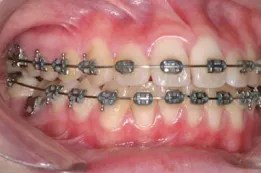
The lower anteriors are now verticalized to the neuromuscular position, replacing the orthosis. The first molars are the remaining teeth to be verticalized to the myocentric position.
Training the Dentist to Diagnose Orthopedically
A growing awareness among cosmetic dentists recognizes that cranial and mandibular bones can be systematically moved to more optimal relationships. Teeth can be rotated, leveled, and aligned to increase occlusal stability. Teeth and surrounding periodontium can be orthopedically grown with light, consistent, non-surgical forces to establish proper crown-to-root ratios. If the general dentist is treating 20–40% of orthodontic patients in the U.S., many dentists do not have adequate training to diagnose and treat the posterior vertical deficient (deep bite, anterior open bite, Class II skeletal) cases to the level of care possible today. If so, why are most cases relying on fixed and removable retainers after orthodontic treatment? Our mission is to train dentists in diagnosis and treatment planning based on sound anatomical/orthopedic concepts with a gneuromuscular approach.
No case can be diagnosed without adequate records for complete diagnosis:
- Detailed medical and dental history — evaluating for airway obstruction, allergies, and tongue function.
- Radiographs — panoramic, lateral cephalograms, submental vertex, tomograms of the TMJ, lateral cervical spine, and AP cephalograms.
- Complete neuromuscular K7 work-up — EMG, sonography, and a complete series of scans including a Scan 4/5 bite registration, Scan 9 resting EMG, Scan 11 functional EMG and Scan 15 ESG to measure and identify underlying temporomandibular joint sounds (clicks and pops) that impact the long term stability of the case.
- Cephalogram with and optimized bite registration.
- Mounted casts to the 6-dimensional physiologic position.
- Photos or images in color — intra-oral facial and standing boy posture.
Diagnosis and treatment planning are made from these records. A written treatment plan is prepared after careful analysis and study, identifying the various musculoskeletal signs and symptoms and mal occlusions and the fee for services at each visit.
Continue Learning
🔹 The Three Clinical Disciplines
- TMD Problems That Challenge Dentistry: Four Main Categories →
- Restorative Dentistry →
- GNM Orthodontics / Orthopedics — (you are here)
🔹 Core Concepts
🔹 Featured Case
🔹 Case Studies
- Retrognathic Maxillary Correction of Anterior Open Bite: Case Study →
- Orthodontic — Pseudo Class III Maxillary Arch Correction with GNM Principles →
- Maxillary Expansion of an Asymmetric Missing Bicuspid Case →
- GNM Ortho/Orthopedics — 44-Year-Old Female with TMD Craniofacial Pain →
🔹 Clinical Concepts and Technique
- Expansion Orthodontics →
- Tongue Posture and Abnormal Swallowing Patterns Contributing to Muscle Activity in Orthodontics →
- Orthopedics/Orthodontics — Beyond Functional Orthodontics →
🔹 The Bicuspid Extraction Question
- Orthopedic/Orthodontics: Extracting Four Healthy Bicuspids to Treat Dental Crowding, Why? →
- 4 Bicuspid Extraction: A Flawed Assertion — An Historical Review of Literature →
🔹 Articles and Perspectives
- Dr. Chan’s Articles on Orthodontic/Orthopedics →
- Medical versus Orthodontic Treatment Models →
- Neuromuscular Considerations from Dr. Chan →
🔹 Training and Registration
Written by Clayton A. Chan, D.D.S. — Founder and Director, Occlusion Connections | Las Vegas, Nevada


